如何构造数据,使得两个字符串的hash值相等
大质数hash 通常,这个质数会选择在 $10^9$ 附近,如 $998244353$,$10^9+7$。
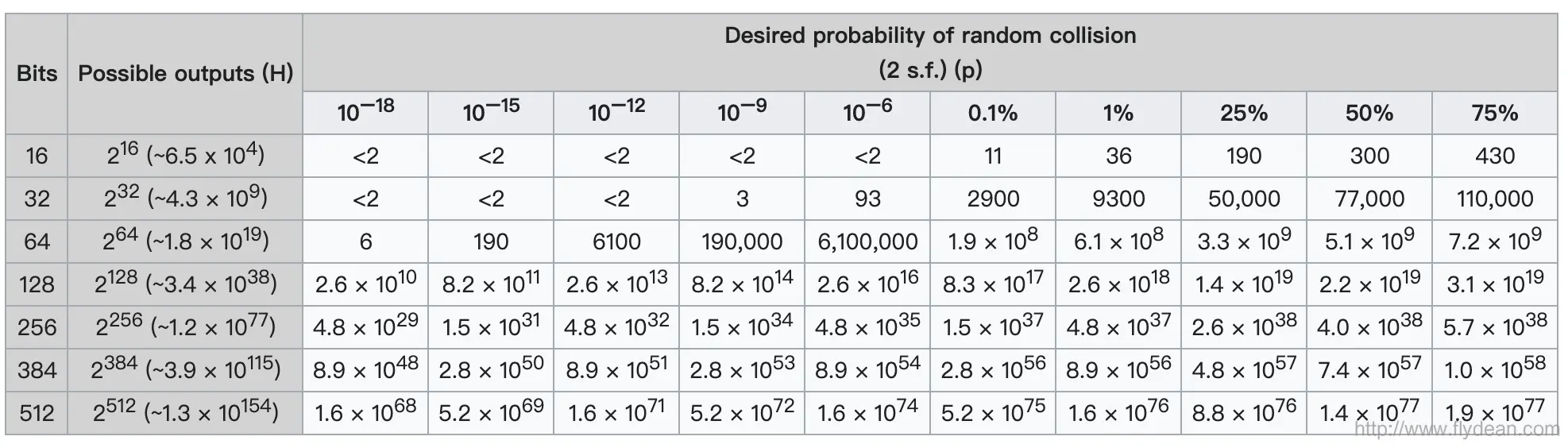
考虑生日碰撞,欲达到 50% 成功率,需要尝试的次数为
可以参考概率表
所以我们可以生成 $10^5$ 左右个较短的字符串,即可有很大的概率发生hash冲突。
Code 1 2 3 4 5 6 7 8 9 10 11 12 13 14 15 16 17 18 19 20 21 22 23 24 25 26 27 28 29 30 31 32 33 34 35 36 37 38 39 40 41 42 43 44 45 46 47 48 49 50 51 52 53 54 55 56 57 58 59 60 61 62 #include <iostream> #include <algorithm> #include <cstring> #include <map> #include <vector> #include <limits.h> #define LL long long #define ULL unsigned long long using namespace std;vector<string> create (unsigned num,unsigned int sze) vector<string>ans; while (num--) { string str; for (unsigned int i=0 ;i<sze;i++) { str.push_back ('a' +rand ()%26 ); } ans.push_back (str); } return ans; } bool check (vector<string>strs,ULL base,ULL p) map<int ,string>Map; for (unsigned int i=0 ;i<strs.size ();i++) { ULL x=0 ; for (unsigned int j=0 ;j<strs[i].size ();j++) { x=x*base+strs[i][j]-'a' ; x%=p; } if (Map.find (x)==Map.end ()) Map[x]=strs[i]; else { if (Map[x]!=strs[i]) return 1 ; } } return 0 ; } int main () srand (time (0 )); int T=100 ,succ=0 ; for (int t=0 ;t<T;t++) { vector<string>strs=create (100000 ,10 ); bool c=check (strs,31 ,998244853 ); cout<<c<<endl; succ+=c; } cout<<succ<<"/" <<T<<endl; return 0 ; }
试运行发现,设置字符串数量为$39623$时,发生hash冲突的概率近似$50\%$,符合预期。而当设置字符串数量为$100000$时,$1000$次测试中只有$4$次没有发生hash冲突。所以设置$10^5$个字符串就差不多可以卡掉绝大多数单大质数hash了。
64位无符号整数自然溢出 首先需要对base奇偶性分类讨论。
当base是偶数时比较简单:设第 $i$ 位指的是字符串从右往左数第 $i$ 个字符,设有相同串 $C$ ,其长度不小于64.构造字符串 $A=a+C,B=b+C$,这两个字符串的后64位上均相同,更高位上不相同。
字符串中第 $i$ 位的权重为 $base^{i-1}$,则高于64位上的字符的权重一定可以被 $2^{64}$ 整除。也就是说,高于64位上的字符不会对hash值产生影响。
下面着重说一下base为奇数的情况。
构造方法 考虑使用字符a和b构造字符串:
记 $\overline A$ 表示字符串 $A$ 中所有 a 变成 b ,所有 b 变成 a。
记 $A_1=a$,$A_i=A_{i-1}+\overline{A_{i-1}}$
例如 $A_2=ab,A_3=abba,A_4=abbabaab$
那么$len(A_i)=2^{i-1}$
可以证明,当 $i$ 大于某个数时,$hash(A_i)=hash(\overline{A_i})$
证明 由于我们的hash函数使用的是64位无符号整数自然溢出,所以相当于我们需要证明
设$f(i)=hash(A_i)-hash(\overline{A_i})$
根据递推公式可得
则有
设$g(i)=base^{2^{i-2}}-1(i\ge2)$
则有
由于 $base$ 是奇数,所以 $base^{2^{i-2}}$ 也是奇数,故 $g(i)$ 是偶数。
故有
为了达到$2^{64}\mid f(i)$,需取$i=65$即可,但是这样会构造两个长度为$2^{64}\approx10^{20}$的字符串,是不可行的。
由于$g(i)=base^{2^{i-2}}-1=(base^{2^{i-3}}+1)(base^{2^{i-3}}-1)=偶数*g(i-1)$
所以有
我们需要$\frac{i(i-1)}{2}\ge64$,则只需取$i=12$,构造出字符串 $A_{12}$ 和 $\overline{A_{12}}$,即可卡掉base为奇数的自然溢出。
最后,在这两字符串后再加上长度大于等于64的相同串,即可同时卡掉base为偶数的自然溢出。
Code 1 2 3 4 5 6 7 8 9 10 11 12 13 14 15 16 17 18 19 20 21 22 23 24 25 26 27 28 29 30 31 32 33 34 35 36 37 38 39 40 41 42 43 44 45 46 47 48 49 50 51 52 53 54 55 56 57 58 59 60 61 62 63 64 65 66 #include <iostream> #include <string> #include <cmath> #include <map> #include <vector> #include <limits.h> #define ULL unsigned long long using namespace std;string C; string create () string str="a" ; for (int i=2 ;i<=11 ;i++) { for (int j=0 ;j<(1 <<(i-2 ));j++) { str.push_back (str[j]=='a' ?'b' :'a' ); } } return str; } string Not (string str) for (unsigned int i=0 ;i<str.size ();i++) { str[i]=(str[i]=='a' ?'b' :'a' ); } return str; } bool check (string a,string b,ULL base) ULL aa=0 ,bb=0 ; for (unsigned int i=0 ;i<a.size ();i++) { aa=aa*base+a[i]-'a' ; } for (unsigned int i=0 ;i<b.size ();i++) { bb=bb*base+b[i]-'a' ; } return aa==bb; } int main () for (int i=1 ;i<=65 ;i++) C.push_back ('a' ); string str=create (); string A=str+C,B=Not (str)+C; cout<<"构造的字符串的长度为" <<A.size ()<<endl; int T=10000 ,succ=0 ; for (int t=0 ;t<T;t++) { bool c=check (A,B,t*2 +1 ); cout<<c<<endl; succ+=c; } cout<<succ<<"/" <<T<<endl; return 0 ; }
疑惑:为什么这里取 $i=11$ 就可以了?
我在研究的过程中,发现取 $i=11$ 时,对于测试的所有奇数base都成功了。但是明明证明的是 $i$ 最小取 $12$?最后由lzh揭开了谜团。
$g(3)$ 很特别:$g(3)=base^{2^{3-2}}-1=base^2-1$
由于base是奇数,设$base=2n-1(n\ge1)$,有
一定是8的倍数。故 $2^3 \mid g(3)$。
再结合递推公式,有
所以有
当 $i=11$时,刚好是$2^{64}$(真巧!)
如何避免被卡
随机base。相当于让不同位置上的权重不一样
双模数hash。
超大质数hash。既能像自然溢出一样有着大值域不易生日攻击,又不会被特殊的构造卡掉。
COMMENTS
via giscus